Your Yacht Charter Guide
Work out which charter suits you, what you will pay and what you need before you book.

Founding Member: International Federation of Yacht Charter Agents

Verified & Protected by Pantaenius Yacht Insurance.
How Do You Charter a Yacht?
A yacht charter is hiring a yacht for a holiday, sailed by you or with a skipper or crew. Choose your destination, dates and boat, check the terms and pay the agreed deposit. Before you pay, make sure the operator accepts your qualifications and gives you the full cost. A deposit does not cap what you owe if you damage the boat through negligence.
Start With the Practical Details
I run SailChecker, a UK yacht charter broker. This guide takes you through the decisions and paperwork, then what happens at the base. Read the parts about licences, insurance and payment before committing.
Quick Navigation
- 1 Choose Your Charter Type Decide Who Does the Work
- 2 Match the Place and Season Weather Comes Before the Route
- 3 Choose Cabins Before Berths Check the Layout and Equipment
- 4 Understand What Drives the Cost Compare the Whole Holiday
- 5 Check What Is Extra Read Beyond the Charter Fee
- 6 Check Who Holds Your Money Read the Operator's Terms
- 7 Confirm Your Licence and Experience Get Acceptance Before You Book
- 8 Read the Contract Before Paying Bring the Original Documents
- 9 Pack Soft Bags and Provision Check What Is Already Aboard
- 10 Give Handover Enough Time Keep the First Leg Short

1.Choose Your Charter Type
Decide Who Does the Work
Bareboat means you sail the yacht yourself, without professional crew. The operator needs evidence that you can handle it. A skippered charter gives you the boat with a professional skipper, who handles navigation, boat handling, dinghy runs and safety briefings.
The skipper needs a cabin. They do not cook, clean, mind children or organise excursions. A tip is expected, at your discretion. Crewed yachts have a permanent crew, usually including a chef, and suit people wanting those jobs covered.
Cabin charter means booking a cabin and sharing a crewed boat with other guests. Flotillas follow a shared route with a lead crew. They suit beginners, families and sociable groups. Unqualified guests can join a Sunsail flotilla with a hired skipper.

2.Match the Place and Season
Weather Comes Before the Route
The far south of the Caribbean is not hurricane-proof. Beryl crossed Carriacou in July 2024. Atlantic hurricane season runs from June to November, though hurricanes can occur outside it. The region's sailing runs on easterly trade winds.
The Aegean's northerly Meltemi is strongest in high summer. France has the Mistral; the Adriatic has the Bora and southerly Jugo. Our South Ionian guide recommends its shorter distances for new sailors and families. A flotilla also gives beginners support.
Thailand's south-west monsoon is wet, roughly mid-May to mid-October; Gulf rain can last into December. Seychelles has north-west monsoon weather roughly December to March and south-east winds May to September. Greece, Turkey and Croatia carry high summer wildfire risk.

3.Choose Cabins Before Berths
Check the Layout and Equipment
Count cabins, not advertised berths. Berths can include converted saloon seating and forepeaks. The certified persons limit does not tell you how many people can sleep comfortably. An owner's version gives more space to one suite and has fewer cabins.
A monohull gives a more dynamic sail. A catamaran gives larger groups more living space and draws less water, but its width can mean higher marina charges. Include the skipper's cabin when checking the layout.
Ask about heads and showers, watermaker, bow thruster, dinghy and outboard. Air conditioning while cruising needs a generator. SailChecker only offers boats up to five years old, for reliability and fewer breakdowns. I would still check the equipment on the particular boat.

4.Understand What Drives the Cost
Compare the Whole Holiday
Dates and boat choice drive much of the cost. Mediterranean summer, Caribbean winter and school holidays cost more. Low season costs less, but the weather is less settled. Age, length, cabins and equipment all affect the boat price.
Monohulls usually cost less than catamarans, and power costs more than sail. Longer boats also cost more to moor. Each destination has its own taxes, fuel and living costs. More people raise the total while reducing the cost per person.
A skipper adds a fee and takes a cabin. In the Mediterranean you also feed them. One-way charters carry a separate fee. Discounts vary by operator. Check the currency too, with Mediterranean fleets mostly pricing in euros and many Caribbean fleets in dollars.

5.Check What Is Extra
Read Beyond the Charter Fee
Neither a deposit nor a damage waiver caps liability for negligent or reckless damage under operators' terms. A waiver is non-refundable and usually reduces the deposit. Read what remains payable.
Bareboat extras usually include fuel, marinas, Wi-Fi, beach towels and mid-week cleaning. Compulsory packs commonly cover cleaning, linen and gas. Ask what 'transit log' means on your quote. UK price rules require compulsory charges in the headline price.
Croatia charges tourist tax for nights aboard. Greece's cruising fee is the owner's or operator's liability. In the EU, VAT on vessel hire of 90 days or less is charged in the handover country. On crewed charters, the advance provisioning allowance funds food, drink, fuel and berths. The captain accounts for spending and settles the balance. A crew tip is customary.
“Before paying a deposit, get the operator's acceptance of your qualifications and the full cost in writing.”
The Art of Charter · SailChecker

6.Check Who Holds Your Money
Read the Operator's Terms
Intermediaries fail. Zizoo went insolvent in 2024 and customers lost down payments. A broker receives commission from the operator or owner out of the charter price. You remain bound by the operator's terms.
Check boat age, base staff, out-of-hours support, deposit liability and the dated terms. Payment and cancellation schedules vary widely. SailChecker's terms require a deposit, then the balance 60 days before charter unless the operator requires it earlier.
A charter without flights has no ATOL protection. Section 75 can make a credit card issuer jointly liable for purchases over £100 and up to £30,000. Payment through another party can affect protection, so check the arrangement. Do not assume yacht-only charter has package holiday protection either.
7.Confirm Your Licence and Experience
Get Acceptance Before You Book
Day Skipper is not enough for Greece with operators such as The Moorings. Sunsail asks for an International Certificate for Operators of Pleasure Craft, or ICC, Coastal Skipper or Yachtmaster. Both require an adult certified skipper and adult able-bodied crew member.
Croatia accepts Day Skipper up to 18 m and ICC up to 24 m, with a radio certificate for VHF. Spain accepts both with limits. France requires no sailing licence in maritime waters. Get operator acceptance too.
An ICC needs practical qualification or assessment. US routes include ASA qualifications followed by its International Proficiency Certificate, or an RYA or IYT ICC. Operators also assess days and miles as skipper on similar boats. Without the qualifications, hire a skipper.
8.Read the Contract Before Paying
Bring the Original Documents
Standard travel insurance usually does not cover sailing. Sunsail and The Moorings require travel insurance. Check cancellation, deposit and skipper liability cover separately. Some skipper policies exclude damage to the boat you are skippering.
Read payment and cancellation terms, negligence liability, wind limits, night sailing restrictions, cruising area and late return charges. Operators set different limits. The Moorings prohibits night sailing at every base. Third-party deposit insurance means paying the operator first and claiming back.
Have everyone's passport details ready for the crew list. Operators send documents ahead, so do not leave this until departure. Take original licences, any required VHF certificate, passports, insurance documents and a credit card for the deposit to check-in.

9.Pack Soft Bags and Provision
Check What Is Already Aboard
Take soft bags as storage is limited. Keep prescriptions, swimwear and a change of clothes in hand luggage. Linen is normally supplied, but check towels and snorkelling equipment. Bring children's lifejackets as supplies at the base can be limited.
Many boats have only 12V and USB power without a generator or inverter. Bring a suitable charger and mineral sunscreen. For seasickness, fresh air and watching the horizon can help. Ask a pharmacist about treatment, and remember hyoscine tablets cause drowsiness and are unsuitable for the helm.
Order provisions ahead or shop on arrival. Crewed charters use preference sheets so the chef knows your diets. Keep all rubbish aboard and land it ashore. Nothing goes overboard, including plastics.

10.Give Handover Enough Time
Keep the First Leg Short
Check boarding, night-before return and morning checkout times before booking flights. Mediterranean Saturday changeovers are conventional; Caribbean arrangements differ. Check your agreement for mooring deadlines, such as an hour before sunset with The Moorings or 5pm with Waypoints and Navigare in the BVI.
Record existing damage before signing. Test the dinghy, outboard, anchor and windlass; check lifejackets, gas, water and fuel. For stern-to mooring, prepare fenders and stern lines, with the lazy line led forward. RYA guidance gives four times the maximum depth at high water for all-chain anchoring.
Check seabed protection, park tickets and mooring restrictions. Common mistakes are clashing flights, missing briefings, a long first leg, unrecorded damage, too little chain, anchoring on seagrass or without a park ticket, late refuelling and returning with full holding tanks.
Tell us where you have in mind, when you want to go and who is coming. Include your sailing experience so we can work through the options.
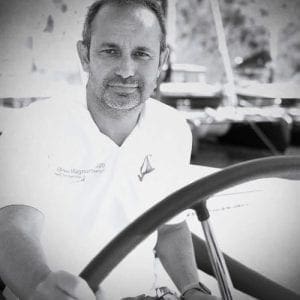
Christopher Lait
Chris founded Drake Academy, a sailing company that provides leadership training to businesses. Now the CEO of SailChecker.com you will find him handling many of your enquiries as he attempts to drive SailChecker.com forward as the company of choice for yacht charter and sailing by focusing on quality advice and great customer service.