
How Much Does It Cost To Charter A Yacht In 2026
A Complete Guide To The Cost To Charter A Yacht

Founding Member: International Federation of Yacht Charter Agents

Verified & Protected by Pantaenius Yacht Insurance.
Quick Navigation
- 1 Yacht Charter Costs, The Full 2026 Breakdown
- 2 How Much?
- 3 The Biggest Factor - Cabins
- 4 The Three Biggest Components Of Yacht Charter
- 5 The Extras, Deposit & Insurance
- 6 Insurance - What's Not Covered
- 7 Recommended Optional Extras
- 8 Adding Crew To Your Yacht Charter
- 9 Leave Us A Quick Question Here, Or Call Your Local Office, The Numbers Are Located In The Footer Below. When Not Arrange A Call Back?
Yacht Charter N. (/jɒt ˈtʃɑːtə/) A Yacht Or Other Boat Available To Hire, Rent, Charter, Etc.
How Much Does It Cost To Charter A Yacht?
Yacht Charter Costs, The Full 2026 Breakdown
Navigating the process of booking the perfect yacht charter typically starts with a budget; more Interestingly trying to understand what that translates into. Could we save money, what difference would pushing the budget have. our most frequently asked question, how much does is cost to charter a yacht starts here.
Understanding the cost is more than just a number, it's about making informed choices for an unforgettable experience. At SailChecker, we're not just intermediaries; we're your independent personal advisors in navigating the complex world of yacht charter pricing, set by operators, not us.
Our expertise isn't just about securing the lowest rate; it's about building relationships with our partners and operators to ensure you get the yacht that's right for you. Here's a deep dive into the factors that shape your charter's cost:
- Number of Guests. The yacht size and guest count directly impact cost efficiency.
- Yacht Type. The vessel's luxury level, age, and amenities play a significant role.
- Season and Duration. Understand how peak seasons and charter length influence rates.
- Location. Destination popularity and transit distances can affect pricing.
- Amenities & Extras. From all-inclusive to plus-expenses, your choices shape the budget.
- Crew. The crew size not only affects base costs but also operating expenses.
- Taxes and Fees. Local taxes and additional fees like APA and transit logs are crucial considerations.
Let's explore each of these aspects to give you a clearer picture of the budget you will need to book the perfect hassle free charter.
How Much Does It Cost To Charter A Yacht At Monoco Grand Prix?
Some Festivals And Events
How Much Does It Cost To Charter A Luxury Motor Yacht?
Some Example Prices
How Much Does It Cost To Charter A Crewed Catamaran?
Some Examples And Prices
How Much Does It Cost To Charter A Bareboat Catamaran? (Qualification Required)
Some Examples And Prices
How Much Does It Cost To Charter A Bareboat Monohul? (Qualification Required)
Some Examples And Prices
With so many variables, it's challenging to give an exact price without understanding the specifics of a charter request. In the next section, we'll break down sample cost ranges for different yacht charter scenarios to shed more light on real-world pricing.
On top of the charter price, it's important to consider expenses. Again they vary wildly from charter to charter. A few examples are:
- Mooring. Some mooring is free, swinging on an anchor, or on a bay tied to the shore are often free. If you enter a town quay or marina, there will be charges based on your length (LOA) and Beam (width). Some marinas are value for money with limited facilities, others eye wateringly expensive.
- Fuel Consumption. If sailing, how much you sail. If motoring, what distances and at what speed. If on a Motor Yacht, you will get an estimate based on your planned route.
- Crew Tips. Vary in different locations. On bigger charters, and in some regions, this can mount up and are expected.
- Bedding. Not always included on value charters.
- Transit Log. If the boat needs to travel across borders.
- APA. The Advanced Provisioning Allowance (aka, Kitty, Cash Box, Purse) run by the yacht to pay for incidental expenses.
- Water Consumption. This varies more than you think. Some crews will shower ashore, others will avoid marinas.
- Food & Drink. The type of food and drink, and how much you eat ashore will have an impact.
Example Of How Much It Costs To Charter A Yacht
As you can imagine, a number of factors make the challenge so tough, some give up and head for simpler vacations to budget for and decide to find out how much it costs to charter a yacht. That's a real shame, here at SailChecker we use a system called a FrameWork Offer. We ask a lot of questions, things have to be as simple as possible, but no simpler, we need this information to estimate How Much It Costs to Charter a Yacht for your circumstances.
Just to give you a sense of the difficulty with telling someone how much it costs to charter a yacht is that, for instance, say a Luxury 46' Catamaran, with 2 crew, can range from $7,000 p.p. per week based on two sharing in the high season, down to just $1,000 p.p. per week (based on 8 sharing) in the low season - that dramatic and those differences exist in all our charter categories.
Quick answer, typical yacht charter costs per week:
- Bareboat (you sail): £3,000–£15,000/week depending on size and season
- Skippered (captain included): £5,000–£20,000/week
- Crewed (full crew, chef, etc.): £15,000–£100,000+/week
- Superyacht (Below Deck style): £100,000–£300,000+/week
Prices vary by destination, season, yacht size, and charter type. Use our price calculator for an instant estimate, or read on for the full breakdown.
If you have never chartered a yacht before, and sometimes, even if you have, the bewildering number of factors that are sometimes included, sometimes not, can be overwhelming. That's why we have created this article how much does it cost to charter a yacht to give you all the information you need and more.
Starting Point
How Much It Costs To Charter A Yacht - What Will My Budget Get Me
Budgets here exclude your travel costs to the base and are based roughly on Mid season and a Median Destination:
So if you have no idea whatsoever how much it costs to charter a yacht, here's an example - it can cost at little as £200, €220, or $240 per person to charter your own yacht for a week.
At the bottom of the market, you will get a 10-year-old yacht, around 32 feet (9m) in length, with two 2-person cabins, plus the saloon space that can accommodate guests too. So if you are up for offseason sailing in Croatia and have the right sailing qualifications, you can sail for as little as €12 per person a day.
That said, it's fairly uncommon, most spend around €5,000+ shared with 2 to 8 people or more, yet there are more expensive options too if you have the budget.
The Big Challenge. Although we can say with some confidence, chartering a yacht is not that difficult, getting it just right can be the challenge. It is rare, but if you do get it wrong, you could face some unwanted costs at the end. Get it right, and you can stay relaxed with all your expectations not just met, but exceeded enjoying the best sailing memories ever.
The Options. These can vary slightly from one charter operator to operator but don't worry; we are here to navigate you through all the options and terminology of the cost to charter a yacht.
If you are chartering regularly or booking for the for the first time, you will find our article an indispensable guide to cost to charter a yacht.
How Much Does It Cost To Charter A Yacht From Prices: Sailing Yachts
Sailing Boats <80ft
$10k+ Per Week
- Bareboat
- Excludes Flights & Transfers
- Self Catering
- Captain +$2k
- Chef +$1.6k
- Hostess +$1.4k
Popular
Sailing Boats >80'
$20k+ Per Week
- With Crew
- Excludes Flights & Transfers
- APA Extra
- +Tax
- Water Toys Included
Sailing Boats >120ft
$50k+ Per Week
- With Crew
- Excludes Flights & Transfers
- APA Extra
- +Tax
- Water Toys Included
Sailing Boats >150ft
$100k+ Per Week
- With Crew
- Excludes Flights & Transfers
- APA Extra
- +Tax
- Water Toys Included
How Much Does It Cost To Charter A Yacht From Prices: Catamarans
FEATURED
Catamarans <50ft
$10k+ Per Week
- Bareboat
- Excludes Flights & Transfers
- Self Catering
- Captain +$2k
- Chef +$1.6k
- Hostess +$1.4k
Catamarans >50ft
$20k+ Per Week
- With Crew
- Excludes Flights & Transfers
- APA Extra
- +Tax
- Water Toys Included
Catamarans >65ft
$28k+ Per Week
- With Crew
- Excludes Flights & Transfers
- APA Extra
- +Tax
- Water Toys Included
Catamarans > 80ft
$50k+ Per Week
- With Crew
- Excludes Flights & Transfers
- APA Extra
- +Tax
- Water Toys Included
How Much Does It Cost To Charter A Yacht From Prices: Motor Yachts
Your Guide To Charter A Yacht
- 1. Yacht Charter Costs: What You Need to Know
- 2. Key Factors Affecting Yacht Charter Pricing
- 3. Understanding the 3 Major Cost Components
- 4. Mandatory Extras: Fees to Consider
- 5. Yacht Insurance Essentials and Costs
- 6. Optional Upgrades for Your Charter
- 7. Adding a Crew: Benefits and Costs
1. How Much?
How Much Does To Cost To Charter A Yacht?
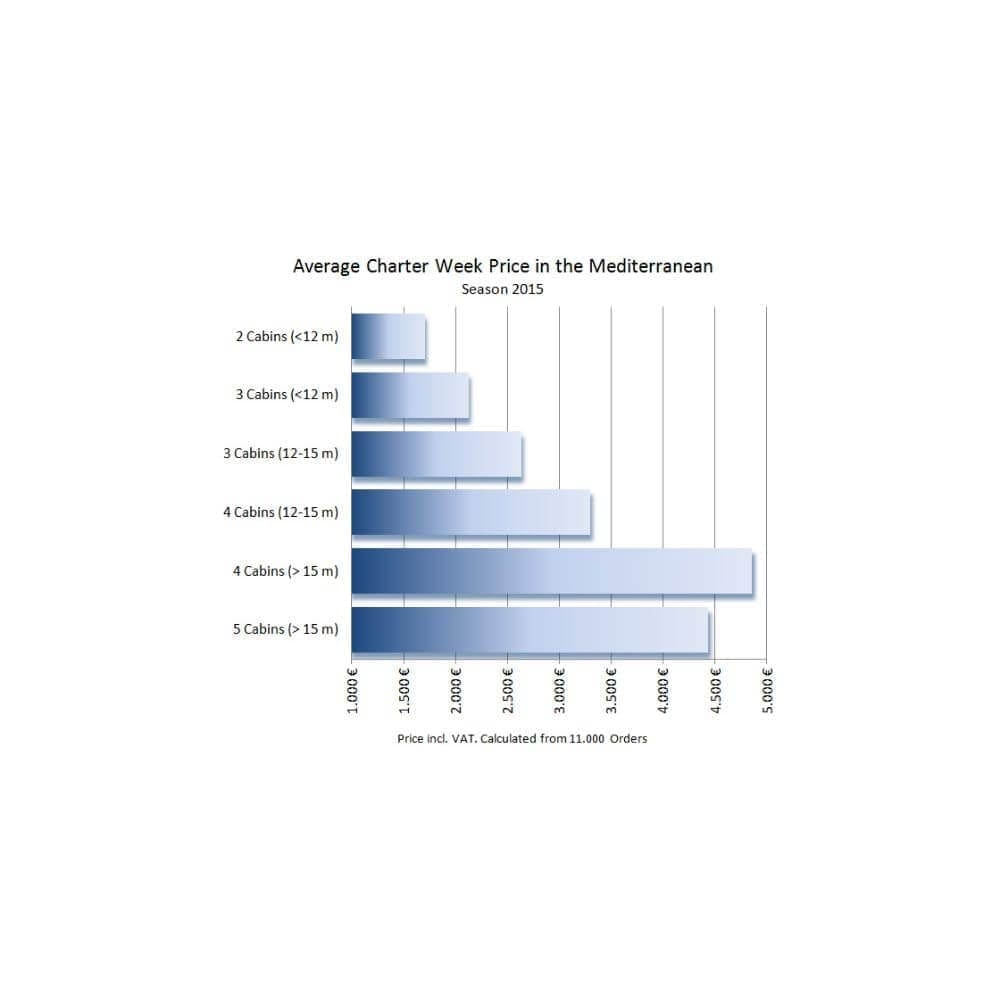
Bareboat Charter Cost. Let's start with the basics. When calculating how much it costs to charter a yacht, the main cost is simply the bareboat charter cost. This is the price before mandatory and optional extras and the one you will be quoted most often. It would help if you usually used this to compare quotes.
Length and Cabins. The next two factors are the length (LOA) and the number of cabins. In the graph below, we have the average cost of bareboat yacht charter in the Mediterranean in 2015 based on cabins and length. Most cabins sleep two people. There are occasionally single cabins and crew cabins (not usually considered suitable for guests).
You might see the number of berths written like this: 8 + 2 +2. This means 8 berths in cabins, 2 in the saloon and 2 crew berths.
2. The Biggest Factor - Cabins
Cabins & Other Major Metrics Of A Yacht
What is a Cabin? Just in case you unfamiliar with the jargon or want to be sure, a cabin is a room of a boat where you sleep. In the vast majority of cases, they are designed for 2, yet there are exceptions.
You might find our blog What is a Cabin Helpful.
What is a Berth? A berth is somewhere to sleep. Hence you might expect to hear someone say it's an 8 berth yacht, referring to the number of people who can sleep on the boat.
Cost Factors. As you might expect, the number of cabins, along with the size of the yacht overall, are the biggest factors when it comes to price (not always - see the finding value tip below.
Top Tip - Finding Value. The trend of the price increasing with cabins ceases at the over 15m category for several reasons. For a start, greater skill and experience is required to safely sail a charter yacht of this size; it is approaching the point where many non-professional skippers no longer feel comfortable. We are also beyond the typical group size, which is generally looking for 3 or 4 Cabins.
You can find extra value for large groups if you hire a 5 cabin >15m Yacht.
3. The Three Biggest Components Of Yacht Charter
A Closer Look At The 3 Main Components Of Price
If you know what type of boat you want and even what model and make, these will all affect the cost of a yacht charter. Needless to say, if it's your first time and you don't know what will suit you, your expert consultant will take you through all the possibilities and cost to charter a yacht. Here's a breakdown:
Type of Boat. There are typically 3 types of boat available to charter in price order:
- Monohulls. A singled Hulled Boat, favoured by some who like the dynamic feel of sailing.
- Catamarans. A Twin Hulled boat with plenty of space between, favoured by those seeking space and additional luxury.
- Motor Yachts/Catamarans. For those looking to get places fast.
Why not read our blog Monohull Versus Catamaran.
Cabins. As mentioned above, the number of separate places to sleep will often go hand in hand with Length.
What Cabins Means to Cost: Typically, the more cabins, the more expensive the yacht, but they can be shared amongst more people to keep costs down.
Length (LOA): The length of the boat from back to front. As boats get longer, they get wider too.
What it Length Means to Cost: It's one of the biggest factors. The most expensive yachts will have a low number of cabins on a large yacht.
Age. How old the boat is.
What Age Means to Cost: Old boats have a salty smell, and there is an increased chance of in-charter maintenance, yet they are cheaper. Newer yachts feel and smell new and are in demand.

4. The Extras, Deposit & Insurance
Dealing With The Small Print
Big Choices Out of the Way. So, by now, you will have chosen the right size, length, age, type, and boat model! Now there are some other extras to be considered, both optional and compulsory.
Variations. There is a variation in how charter operators deal with this; for example, towels and sheets are included in the cost of a yacht charter; for others, it's part of a mandatory starter or welcome pack.
Deposit. It would help if you also considered the cost to charter a yacht, that you would have to pay a deposit to cover any damage up to the price of the deposit. The operator's insurance policy covers any damage after that.
Final Cleaning. Sometimes included, sometimes added as a compulsory extra or included in some other compulsory element like a comfort pack. Most companies will not allow you to clean the boat yourself.
Insurance. Boats are typically insured against:
- Risks arising from liability to third parties and damage to the hull
- Machinery and equipment
- Third-party liability
- Sea pollution liability

5. Insurance - What's Not Covered
Learn All About The Different Types Of Insurance
In each case below, the chances of being involved with something going to get bills spiralling are low, but we think it's well worth looking at what they are and what you can do about them.
Liquidation Liability. Although it's scarce, your operator could go out of business. This is something for you to consider and look to insure against.
The Deposit. It's worth mentioning again that you can stand to lose all of your deposit if something happened. There are insurances available in some jurisdictions that can insure against this liability (Do ask your charter consultant for advice on this).
Change of Circumstances. Our clients are often booking a long way in advance, so be aware that your initial deposit is non-returnable. You may want to seek out insurance to cover cancellation.
Holiday Insurance. Just like any holiday, there is the chance that you need to use local medical facilities, or you could lose your luggage. We do recommend that you seek out adequate insurance cover for your needs.
Often Mandatory With Insurance
- Starter Pack/Welcome Pack
- Transit Log
- Final Cleaning
Usually Optional
- Spinnaker
- Windsurf
- Kayak
- SUP
- Safety Net
- Extra Linen
- Beach Towels
The charter cost also usually requires a safety deposit which will vary depending on the boat's length.

6. Recommended Optional Extras
There's Always Extras - What You Need To Know
Outboard Engine.
Whilst an Outboard Engine is strictly an option with most fleet operators, it is optional, it's not for most people.
Some charter companies include this cost to charter a yacht, others separate it, whilst a few offer different sizes. Expect to add €80 to your cost to charter a yacht to have one included, or if you’re feeling athletic, you can always row ashore!
Safety Net. If you are sailing with children, a safety net rigged around the guard rails is necessary. Expect around €80 for one to be added.
You can read more information on family sailing on our page is it Safe to Travel with Children.
Adding Crew To Your Yacht Charter

The Cost Of Adding Crew To Your Charter
Private Cruise...
... add affordable crew
If your expected cost to charter a yacht allows, why not add a hostess or a cook? For the cost to charter a yacht, this is an effective way of arranging something very tailored and great value for money. At around €100 a day (a little more for a cook), the crew will look after your every need.
A point to note, you will be expected to include the food costs of your crew, so allow for this when planning the cost to charter a yacht.
Skipper. Let a professional sail the boat for you; using their expert professional knowledge, they can find the best possible routes, places to drop anchor and swim.
Cook. Get the very best local produce cooked by a professional chef who will create delicious meals.
Hostess. Sit back and relax while your hostess serves food, drinks and helps out around the boat.
Got A Burning Question About How Much Does It Cost To Charter A Yacht?
We're Happy To Answer Any Yacht Charter & Sailing Question
Leave Us A Quick Question Here, Or Call Your Local Office, The Numbers Are Located In The Footer Below. When Not Arrange A Call Back?
If you have any questions on how much does it cost to charter a yacht, please get in touch soon and we would be delighted to help.
Related Reading:

Christopher Lait
Chris founded Drake Academy, a sailing company that provides leadership training to businesses. Now the CEO of SailChecker.com you will find him handling many of your enquiries as he attempts to drive SailChecker.com forward as the company of choice for yacht charter and sailing by focusing on quality advice and great customer service.