Celestial Navigation

How Do I Find The North Star


Two stars in the Plough point straight at it, and once you have seen the line you never lose it.

Award Winning
Best Yacht Charter Company
High Touch Service
Industry Leading Consultants
Every Boat, Every Location
Insured Professional Fleets
Rated 4.9 out of 5 on Trustpilot

Rated 4.9 out of 5 based on 258 reviews on Trustpilot

Founding Member IFYCA

Founding Member: International Federation of Yacht Charter Agents

Pantaenius Yacht Insurance

Verified & Protected by Pantaenius Yacht Insurance.

Charter Payment Protection
Insolvency Protection
Safe Payment
Multi-Currency · Lossless Forex
Low Price Guarantee
Exclusive Deals · No Hidden Fees

How Do I Find The North Star

Ask a navigator how they find Polaris and they will not reach for a star chart. They will describe a shape: seven bright stars that most people already know, and a line drawn from two of them. That is the whole method, and it works from the deck of a yacht with no instrument at all.

The North Star is not the brightest star in the sky, which is where most people go wrong. It is a modest star that happens to sit within a degree of the north celestial pole, the point the Earth's axis aims at, so it holds still while everything else turns around it. That stillness is what makes it useful, and it is also what lets you confirm you have the right star.

We have advised on charters since 2011 and we are tied to no operator, so this is written the way we would explain it on a night watch: the shape first, then the line, then what the star actually tells you.

Find The Plough First

1.Find The Plough First

The Shape Almost Everyone Already Knows

Everything starts with the northern hemisphere. If you are south of the equator, Polaris is below your horizon and no amount of looking will help. Close to the equator it sits so low that haze and shipping lights tend to win. From the Mediterranean northwards you are on comfortable ground.

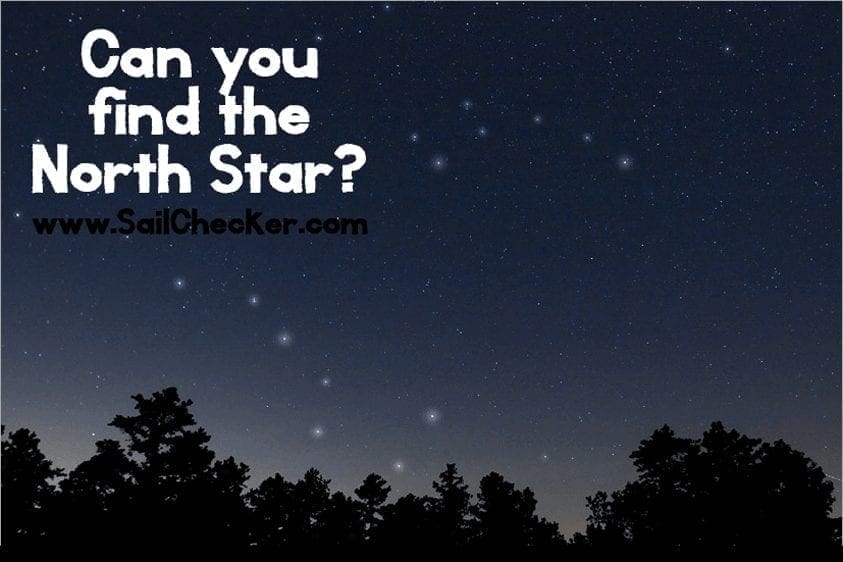
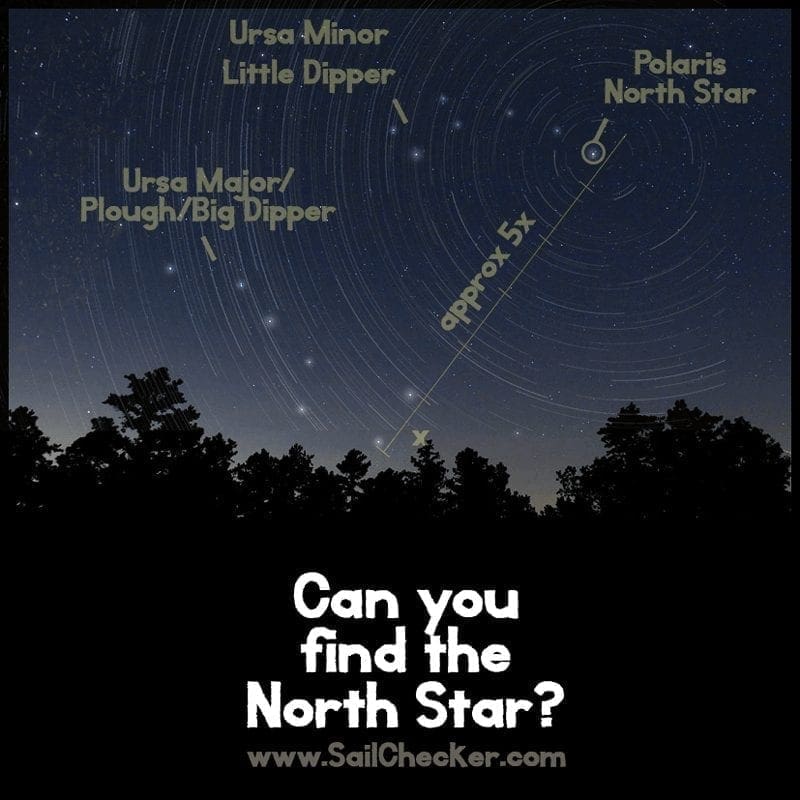
Now find the Plough. Seven bright stars in a shape that reads as a saucepan: four making the pan, three making a bent handle. It is one of the most recognisable patterns in the sky and most people can pick it out without ever having been taught. The names cause more confusion than the stars do. The Plough, the Big Dipper and Ursa Major all refer to the same seven stars, depending on where you learned them. British sailors tend to say Plough, Americans say Big Dipper, and Ursa Major is the wider constellation that contains them.

Look north and give your eyes time. Fifteen minutes away from the cockpit lights does more for you than any technique, which on a yacht usually means asking whoever is on watch to kill the deck lighting for a few moments. From northern latitudes the Plough wheels around the pole and stays above the horizon all night. Further south it can swing low enough to sit in the haze, so a clear view to the north matters more than it sounds.

Follow The Pointer Stars

2.Follow The Pointer Stars

Two Stars, One Line, Five Times The Gap

The two stars you want form the outer edge of the pan, the side furthest from the handle. They are called Dubhe and Merak, and navigators have known them as the pointers for as long as anyone has been writing this down. You do not need the names to use them. You need to see that they make a short line, and that the line runs in a direction: up from the base of the pan, through the lip, and onward out of the constellation.

Extend that line. Keep going for roughly five times the gap between the two pointers and you arrive at a lone star sitting in a fairly empty patch of sky. That is Polaris. It is not dazzling, and nothing of comparable brightness sits near it, and that isolation is the real identifier. If you have landed on something bright with company around it, you have overshot or drifted off the line.

You can confirm it from the other side. Polaris is the last star in the handle of the Little Dipper, Ursa Minor, which is fainter and harder work from a boat with any light spilling about. If that faint curve resolves out of the dark with your star at the end of it, you have the right one.

The Plough turns through the night and through the year, so the pan can sit above the pole, below it, or standing on end. The pointers still point. That is the part worth committing to memory: the shape rotates, the relationship does not, and the original version of this trick tells you to use the two right hand stars, which only holds if the constellation happens to be sitting the right way up.

What Polaris Tells You

3.What Polaris Tells You

True North, And Your Latitude For Free

The first thing Polaris gives you is true north, not magnetic north. Because it sits so close to the celestial pole, a bearing taken on it is a bearing on the true meridian. Your steering compass reads magnetic and carries variation that changes with where you are, so being able to see true north with your own eyes is a genuine cross check on an instrument you would otherwise have to trust blindly.

The second thing it gives you is your latitude. In the northern hemisphere the angle between Polaris and the horizon is your latitude, near enough. Sail in the Solent at roughly 50 degrees north and Polaris sits high, around half way up the sky. Sail in the Caribbean at around 18 degrees north and it drops to about a third of that height, low over the water. Measure the angle with a sextant and you have your position north to south, which is exactly how it was done for centuries before anyone could reliably fix longitude at sea.

You do not need a sextant to feel it. A closed fist held at arm's length covers roughly ten degrees of sky, so counting fists from the horizon up to Polaris gives you a rough latitude in about five seconds. It will not navigate the boat for you. It will tell you, on a dark passage with the plotter behaving oddly, whether the sky agrees with the screen.

None of this is required to enjoy a week afloat, and nobody will ask you to prove it at handover. It is the kind of thing that makes a night watch better, and crews who pick it up tend to spend the small hours looking up rather than down at a screen. If you want more of the practical side, our sailing navigation tips cover what is worth knowing before you take a boat out, and learning to sail in the sun is the usual route in for people who decide they want to do it properly.

Thinking about a week where the nights are as good as the days? Tell us who is sailing and roughly when, and we will come back with the honest all in cost.

Give us a call or send us an email.

We’re here to help.


Amazing Sailing Experiences

What our customers say

4.9 / 5

Based on 215 reviews

Read reviews on ★ Trustpilot
Group Sailing
Christopher Lait

Christopher Lait

Chris founded Drake Academy, a sailing company that provides leadership training to businesses. Now the CEO of SailChecker.com you will find him handling many of your enquiries as he attempts to drive SailChecker.com forward as the company of choice for yacht charter and sailing by focusing on quality advice and great customer service.


Saved for later

This boat now lives on your own private page, along with anything else you save. No account needed.