Sailing Puzzle

Learning To Sail: What Happens Next?


One photograph, three answers, depending on how long you have been sailing.

Award Winning
Best Yacht Charter Company
High Touch Service
Industry Leading Consultants
Every Boat, Every Location
Insured Professional Fleets
Rated 4.9 out of 5 on Trustpilot

Rated 4.9 out of 5 based on 258 reviews on Trustpilot

Founding Member IFYCA

Founding Member: International Federation of Yacht Charter Agents

Pantaenius Yacht Insurance

Verified & Protected by Pantaenius Yacht Insurance.

Charter Payment Protection
Insolvency Protection
Safe Payment
Multi-Currency · Lossless Forex
Low Price Guarantee
Exclusive Deals · No Hidden Fees

Learning To Sail: What Happens Next?

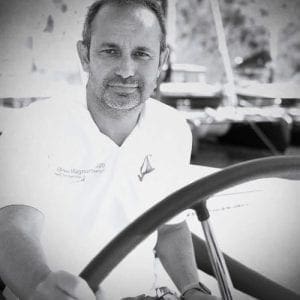
You may have arrived here chasing the answer to one of our lighthearted sailing puzzles. If not, here is the setup. We showed our followers a single photograph of a crew member at the winch and asked them to work out what happens next, with answers pitched at beginner, intermediate and advanced.

There is no single right answer, which is rather the point. A good sailing photograph carries several layers at once, and which layer you notice first is a fair measure of how much time you have spent aboard. The beginner sees which way the yacht is leaning. The intermediate sees why. The advanced sailor sees what the crew member has done with the turns on the winch.

We have advised on charters since 2011 and we are tied to no operator, so what follows is the version we would give you on the dock.

Spotting A Port Tack

1.Spotting A Port Tack

What The Heel And The Horizon Tell You

Start with where the camera is: aft, looking forward from the stern. The yacht is heeling to port, which is left if you were facing the bows, and that one observation names what she is doing. She is on a port tack.

The name matters more than it sounds. Which tack a yacht is on decides who gives way when two sailing boats meet: a yacht on port tack keeps clear of one on starboard. It is the first piece of sailing vocabulary that stops being trivia and becomes a rule.

The second thing worth naming properly is in her hands. It is not a rope. Rope is what it was called before it came aboard and got a job. Once it controls a sail it is a sheet, and nautical types are particular about this.

What she is preparing to do is tack: turn the yacht through the wind so the sails cross to the other side. For the opposite manoeuvre, turning away from the wind rather than through it, our note on bearing away covers it.

Why A Yacht Heels

2.Why A Yacht Heels

The Wind Pulls And The Keel Converts

Now look at the horizon rather than the boat. It runs at an angle across the frame, and that tilt is the whole of the intermediate answer. She is not level, and she is not level for a reason.

Wind flowing across the sail does not simply push the boat along. It pulls her sideways as well, and quite hard, which is what lays her over. That sideways force is where the sailing actually happens.

The keel is what turns it into something useful. Hanging below the hull, it resists the sideways movement, and because the water will not let the boat slide across it, most of that force is redirected into forward motion. The wind pulls sideways, the keel refuses, and the yacht goes forward instead. Take the keel away and you would simply crab off downwind.

Heel, then, is not a fault. Within reason it is evidence that the sail is loaded and the boat is doing its job. Crews new to sailing tend to find the first few degrees alarming and the next few rather good fun.

The Racing Tack

3.The Racing Tack

Two Extra Turns And A Loop On The Winch

This is where the advanced sailors earned it. Look closely at the winch and you will see two extra turns laid around it anti-clockwise, finishing in a loop rather than a tail.

That is deliberate. When she lets go with her right hand, two of the clockwise turns unravel immediately, leaving a single clean turn on the drum. One turn is exactly what you want as the new sheet is let draw: enough grip to keep control of it, and enough movement to pull any kinks out of the sheet as it runs.

It is a racing habit, and not every skipper approves. Loading a winch so that turns are designed to come off is the sort of thing that goes wrong loudly if you misjudge it. On a cruising yacht, though, where the winches are almost always self-tailing, it is a tidy trick and one we are rather fond of.

If you enjoyed picking that apart, the same format runs through our yacht racing for dummies series, which sets a harder photograph.

Learning It On The Water

4.Learning It On The Water

From The Baltic To Your Own Charter

The photograph came from a week in the Baltic, sailing out of Germany through Denmark and Sweden and back. Nobody aboard was on a course. They were on holiday, and the learning happened anyway, which is how most of it happens.

That is worth knowing if you are weighing up whether you are ready to charter. The real question is not whether you can sail, it is how much of the sailing you want to do, and that runs as a spectrum. Sail it yourself, if your experience and paperwork stand up. Add a skipper to the same boat, which is the most common choice and much the best way to learn. Or take a fully crewed yacht and let someone else run the week.

Adding a skipper does not get you a lesser boat. It is the identical hull with a professional aboard, so you can move along that spectrum without changing what you are chartering.

What an operator accepts as evidence of experience varies by country and by company, so it is worth checking before you book rather than after. Our page on the International Certificate of Competence is a sensible place to start.

Learning to sail and wondering what you are ready for? Tell us who is coming and roughly when, and we will come back with the honest all in cost.

Give us a call or send us an email.

We’re here to help.


Amazing Sailing Experiences

What our customers say

4.9 / 5

Based on 215 reviews

Read reviews on ★ Trustpilot
Group Sailing
Christopher Lait

Christopher Lait

Chris founded Drake Academy, a sailing company that provides leadership training to businesses. Now the CEO of SailChecker.com you will find him handling many of your enquiries as he attempts to drive SailChecker.com forward as the company of choice for yacht charter and sailing by focusing on quality advice and great customer service.
Saved for later

This boat now lives on your own private page, along with anything else you save. No account needed.