Five Of The Best Beaches In Greece To Sail To
The bays that only make sense from the water, and the right week to reach each one.
Five Of The Best Beaches In Greece To Sail To
Greece has more coastline than almost anywhere in Europe and several thousand islands and islets, so any list of its best beaches is really a list of arguments. What settles the argument for a sailing crew is access. The beaches that make a charter memorable are the ones a car cannot reach: a bay under a cliff with no road down, a cove on the wrong side of an island, a sandbar that only works as a destination if you arrive by boat.
All five below fit that. Some are famous and busy by noon, which matters more than the guidebooks admit, because arriving on your own keel means turning up before the day boats or long after they have gone. Others are quiet simply because they are awkward to reach.
Greece also sails in two halves. The Ionian, the Saronic and the Sporades give you milder winds and forgiving bays, which is why most first charters start there. The open Aegean asks more of a crew, particularly in high summer. We have advised on charters since 2011 and we are tied to no operator, so where one of these beaches belongs to a different week than the one you are planning, we will say so.
Quick Navigation
- 1 Shipwreck Beach, Zakynthos The Bay With No Road Down
- 2 Kolymbithres, Paros Granite Coves In Naoussa Bay
- 3 Elafonisi, Crete Pink Sand, And A Long Way South
- 4 Simos, Elafonisos Twin Bays Off The Peloponnese
- 5 Kapari, Mykonos The Cove Mykonos Forgot
- 6 Sailing To These Beaches Which Week Fits Which Coast

1.Shipwreck Beach, Zakynthos
The Bay With No Road Down
Navagio, on the north west coast of Zakynthos, is the photograph everyone has already seen: a rusting freighter half buried in white shingle, a wedge of turquoise water, and limestone cliffs standing straight up on three sides. It earns a place on a sailing list rather than a driving one for one reason. There is no road down. The clifftop viewing platform is as close as a car gets, so everyone on that sand arrived by boat.
That does not make it quiet. Day trip boats run from the harbours on either side through the middle of the day, and from late morning to mid afternoon the bay holds far more people than the pictures suggest. Early and late it is a different place entirely. Treat it as a swim and lunch stop rather than a night anchorage: the bay is open and cliff backed, and crews usually move on to sheltered water before dark.
Zakynthos gets written off as a party island on the strength of one street in Laganas. The rest of it, the blue caves along the northern tip and the quieter bays down the east coast, is calmer than its reputation. If you are working out how the wider route joins up, our guide to a Greek islands catamaran charter covers where the islands sit relative to one another.

2.Kolymbithres, Paros
Granite Coves In Naoussa Bay
Kolymbithres sits inside Naoussa Bay on the north coast of Paros, and the rock is what makes it unusual. Wind and water have worked the granite into smooth grey shapes that fold the shoreline into a run of small separate coves, each holding a few metres of sand. From the water it reads as one beach. From the beach it reads as a dozen, which is why it absorbs a crowd better than its size suggests.
Anchoring off and taking the tender in is the natural way to do it, and the bay is large enough to give you a choice about where you sit. There are a handful of tavernas ashore rather than a strip of them. Naoussa town at the head of the bay is a short hop and worth an evening: a working fishing harbour that has kept its scale while much of the Cyclades has not.
Paros stayed comparatively unbothered while Mykonos and Santorini went the other way. It is also, like everywhere in this group, subject to the meltemi, the northerly that can blow hard and for days at a stretch through July and August. That wind is the single biggest factor in how a Cyclades week actually turns out, and it is worth planning around rather than hoping past.

3.Elafonisi, Crete
Pink Sand, And A Long Way South
Elafonisi sits at the far south western corner of Crete and looks like nowhere else in Greece. The sand carries a pink cast, the result of crushed shell worked through it over time, and the water inside the lagoon stays shallow enough to wade a long way out. It is a protected nature reserve, which is why it has never been built on, and that warm shallow water makes it the easiest of these five for families with small children.
The honest caveat is distance. Crete lies well south of the main charter grounds, and its western and southern coasts are exposed, so Elafonisi almost never appears on a standard week out of Athens or Lefkas. Reaching it under sail means a charter built around Crete specifically, or a longer one way passage with the time to do it properly.
Worth saying plainly rather than burying. Plenty of best beaches lists set Elafonisi alongside anchorages you could visit in the same week, and they are not comparable trips. If Crete is genuinely what you want, it is a route we can plan and price. If it is not, there are beaches in the Ionian and the Cyclades that give you a similar day without the passage.

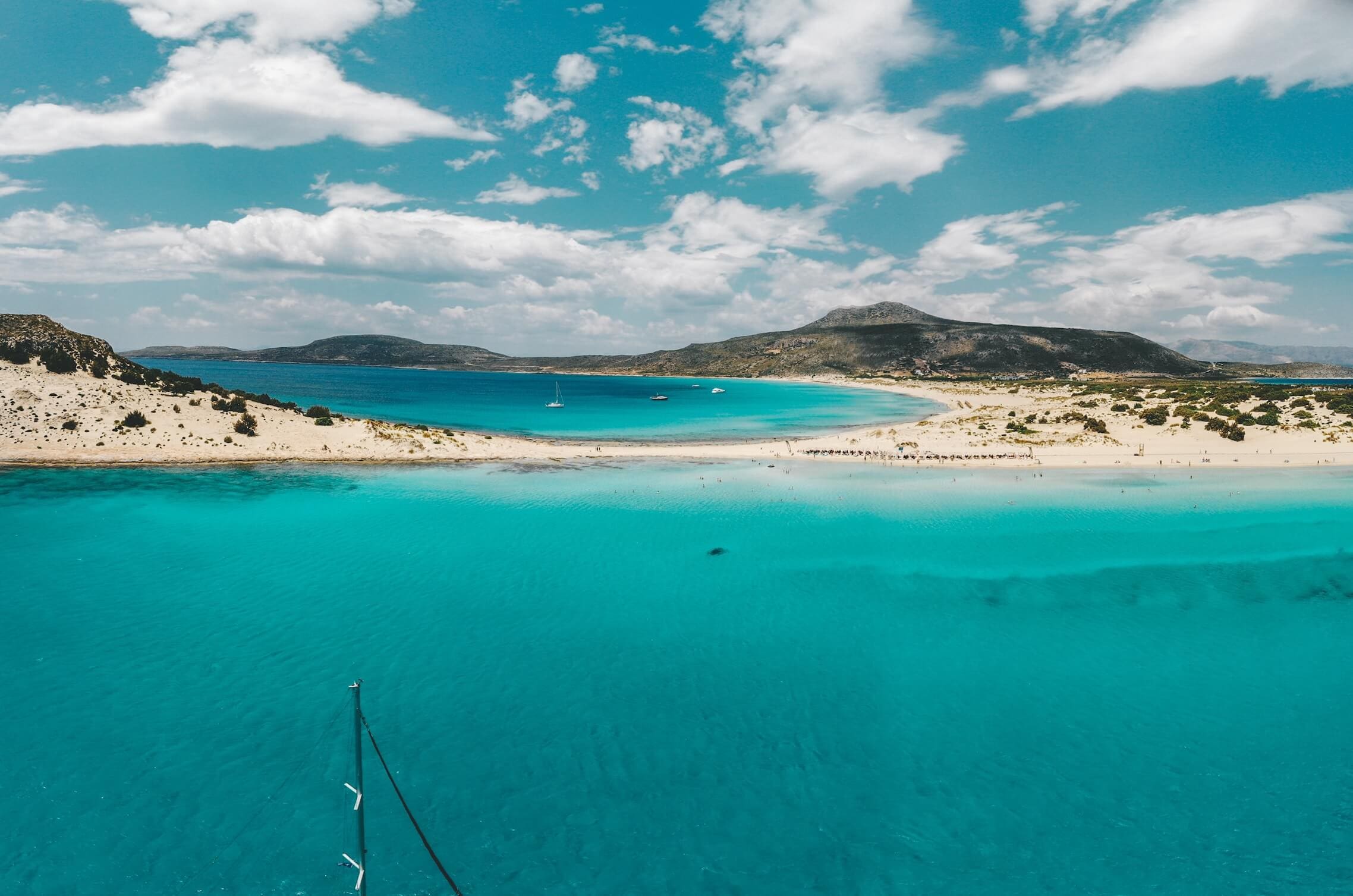
4.Simos, Elafonisos
Twin Bays Off The Peloponnese
Elafonisos is a small island off the southern tip of the Peloponnese, and Simos is really two beaches, Megalos Simos and Mikros Simos, joined by a narrow neck of sand so the whole thing forms a rough X. The sand is white and fine, the water shelves gently, and the comparison people reach for is the Caribbean rather than the Mediterranean. For once it is not far off.
Its position is the interesting part for a sailing crew. Elafonisos sits on the route between the Peloponnese and Kythira, a passage more crews should make and few do, so the island sees a fraction of the traffic of the headline Cyclades stops. Everything arriving by road comes across on a short ferry, and that is a natural cap on numbers.
It still fills in August, and the bay is open enough that a windy day makes it an uncomfortable place to sit, so early in the day or outside the peak weeks is the version worth having. This stretch of coast is a good deal less daunting with a professional aboard, and our guide to a Greece yacht charter with skipper covers what that arrangement is like day to day.

5.Kapari, Mykonos
The Cove Mykonos Forgot
Mykonos sells its beaches by the sunbed. Most of the well known ones run end to end with a bar behind and a day rate to sit down, which is a fair trade if that is the holiday you came for and a poor one if it is not. Kapari, a small cove on the western side of the island near Agios Ioannis, has so far escaped all of it.
Nobody has built on it, so it stays a curve of pale sand and clear water with room to anchor off and swim in. It faces west, which puts the sunset in front of the cockpit, and it sits on the side of an island that takes the meltemi about as hard as anywhere in the Cyclades. That is the practical reason to know it: when the northerly is up, a west facing cove is the difference between a good afternoon and a rolling one.
Mykonos town is close enough to go ashore for the evening and come back to a quiet bay, which is the whole argument for seeing this island from a boat rather than a hotel. You get the part that is worth the fuss, and you sleep somewhere else.

6.Sailing To These Beaches
Which Week Fits Which Coast
These five are not one itinerary. Zakynthos belongs to an Ionian week, Paros and Mykonos to a Cyclades one, Elafonisos to the Peloponnese, and Crete to a charter built around Crete. Any list that presents them as a single route is selling you a set of photographs rather than a week's sailing.
Where you go should follow who is aboard. The Ionian, the Saronic Gulf and the Sporades have milder winds, shorter hops and forgiving bays, which is why most first charters start in one of them and why they suit mixed crews and children. The open Aegean and the Cyclades ask more of you, particularly in the meltemi months, and are more rewarding for it. There is no wrong answer, only a mismatch between a crew and a cruising ground, and that is the mistake worth avoiding.
How much of the sailing you do is a separate decision. Sail it yourself if you hold the qualifications and recent miles. Add a skipper to the same boat if you would rather not carry the responsibility, which is what most crews choose. Or take a fully crewed yacht and have the week run around you. Adding a skipper does not mean a smaller or lesser boat, it is the same hull with a professional aboard.
Whichever way you go, ask for the all in number before you compare anything: base rate, skipper, fuel, berthing, end cleaning and any local tax. Greek quotes vary in what they include, and the gap is where a week gets expensive after you have committed. We have advised on charters since 2011, we are tied to no operator, and we will give you the honest all in cost before you decide. If you want more coastline to choose from, our longer round up of the best Greek beaches runs to thirteen.
Planning a sailing week in Greece? Tell us who is aboard and roughly when, and we will come back with the honest all in cost.
Give us a call or send us an email.
We’re here to help.
Amazing Sailing Experiences
What our customers say
Christopher Lait
Chris founded Drake Academy, a sailing company that provides leadership training to businesses. Now the CEO of SailChecker.com you will find him handling many of your enquiries as he attempts to drive SailChecker.com forward as the company of choice for yacht charter and sailing by focusing on quality advice and great customer service.